
This critical analysis paper was submitted for my Principles of Sociology class in May 2026
In exploring the challenge of arriving at an operational definition of the term ‘single parent’, the 6th edition of Elements of Sociology by John Steckley (2023) offers nine examples to illustrate what a single parent family might look like (p. 68). Interestingly, not one of these examples includes a situation in which the single parent is – and has always been – the only parent. This is perhaps because the status of single parent mainly continues to be viewed as pitiable, one that is ascribed to (rather than achieved by) an individual following “negative life circumstances such as divorce, death of a partner, unplanned pregnancy, or a breakup” (Scott, 2019, p. 144). Choosing single parenthood may still appear inconceivable – or admirable or irresponsible or any other adjective signifying non-normativity – to those who would not choose this status for themselves. This analysis employs Dorothy Smith’s standpoint theory as I draw on my lived experience as a single parent as a source of knowledge (Steckley, 2023, p. 20), as well as Erving Goffman’s social stigma theory to explore how the deviance of single parenthood – even when chosen – has the potential “to discredit an individual’s social identity” (Steckley, 2023, p. 163) as the existence of single parent family units continue to threaten social norms.
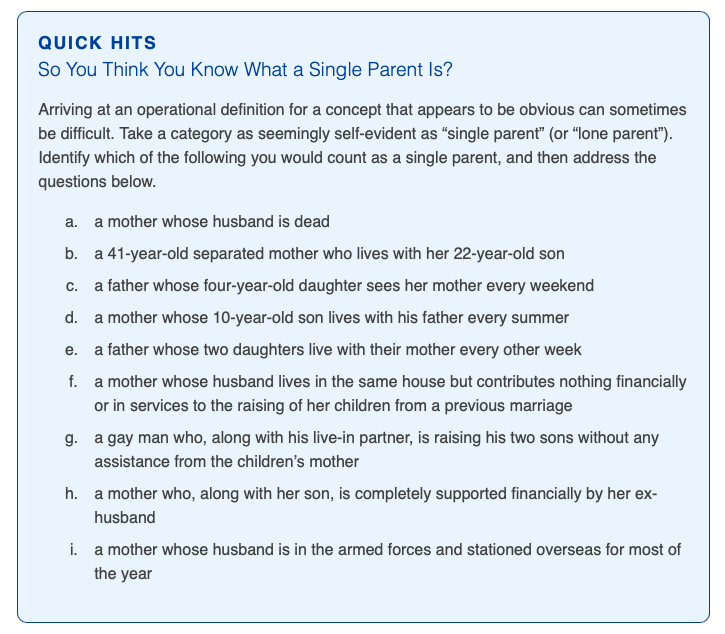
When people find out that I am a single parent, there is often the assumption that there must be another parent in the picture, or that there must have been one at some point. In fact, I am the only parent to my daughter, Joy, whom I adopted on my own at her birth. My circumstances differ significantly from the type of single parent who shares custody with a former partner and has their child living with them every other week, or even less frequently. While Joy spends time with my mother (her grandmother) on weekends, I am the only person who is legally and financially responsible for my child, as well as the only person listed on her birth certificate. My status as a single parent is an object of curiosity for many people I encounter and occasionally becomes a source of contention when I fill out forms related to my child and family makeup. While the term single parent is more commonly used and recognized, I prefer ‘solo parent’ as it places less emphasis on my relationship status (single vs. partnered). Whether or not I am dating someone does not change the fact that I am my child’s only parent. I draw from the term ‘solo poly’ defined as “a relationship style that focuses on yourself as your primary partner while still cultivating intimate connections with others” (Herrera, 2023). My version of this concept recognizes my family unit as my ‘primary partner’ and everyone else as members of our community, regardless of the nature of my personal relationship to them.
Another term that has been utilized for my parental identifier is ‘lone parent’. According to Statistics Canada, a lone parent is “(single, separated, married, or divorced) living together in the same dwelling with at least one child”. One of the final questions on the 2024 City of Ottawa Child Care & Early Years Family Survey asked, “Are you a lone-parent (raising a child(ren) without the support of another parent or caregiver)?” I shared this on my Facebook profile shortly after filling out the survey and included this musing “This label for the type of solo parent I am initially made me feel sad (am I a loner??), but then I thought of the phrase ‘lone wolf’ and Elisapie’s song ‘Wolves don’t live by the rules’ (a current favourite of Joy’s), and felt hella better” (Ruano, 2024). Even though loneliness is sometimes a factor in my experience as a solo parent, I recognize that pursuing a nontraditional existence beyond the “path of least resistance” requires determination in the face of normative societal messaging, and solidarity can still be found within community (Johnson, 1997, p. 26).
Employing Goffman’s theory of social stigma, Sayra Khan’s 2025 qualitative study on single mothers in Dhaka City notes that “Single mothers often face stigmatization due to perceived character traits that deviate them from social norms” (p. 3). Similarly, the authors of “Going it Alone: A Multigenerational Investigation of Women’s Perceptions of Single Mothers by Choice Versus Circumstance” explore the stereotypes that persists about single mothers, who are “associated with financial struggles and solitude” and “often stigmatized and seen as less responsible and well-adjusted, and more miserable and lonely compared to married women” (Scott, 2019, p. 145). However, the study that surveyed 230 female respondents from the West Coast of the United States noted that, beyond concerns about the single mother’s ability to provide financially, “Single mothers by choice were regarded as having the advantage of planning their pregnancy (as compared with single mothers by circumstance) as well as greater autonomy over parenting decisions” (Scott, 2019, p. 156). Still, “The majority of participants (58%) indicated no interest in being a single mother by choice [because they believed] children need both parents to have a better life emotionally and physically” (Scott, 2019, p. 157). The article also references a 1999 qualitative study by V. S. Mannis of ten single mothers by choice, financially independent at the time of conception, in which “the majority of participants reported concern regarding social stereotypes and stigmas against single mothers; however, they viewed the emergence of social change and support from their community as central sources of encouragement for their decision to parent solo” (Scott, 2019, p. 146). Likewise, as a prospective adoptive parent, I had to prove to the Children’s Aid Society that I was prepared financially to raise a child on my own using all my available resources and community support. However, this plan did not take into account the yet unknown effects of the Covid-19 global pandemic.
A longitudinal study titled “The Multiple paths of lone parenthood” followed the trajectories of lone-parent families in Switzerland starting in 2012-2013 and continued through the onset of Covid-19. In the researchers’ subsequent paper consisting of semi-structured interviews with the participants, they focus on employment and family in the context of a global pandemic. “While we know that, ordinarily, help with childcare is crucial for lone mothers to sustain employment […], severe restrictions to social interaction may have limited the availability of this kind of support in the context of the pandemic” (Sánchez-Mira, 2021 p. 4). As a lone parent whose child was born in January 2020, the pandemic upended my intention to raise my child within a vast and multifaceted community and also affected my ability to work fulltime. Similar to the single mothers interviewed in the aforementioned V. S. Mannis study, I was also financially independent before Joy was born, but due to various life events beyond my control, including being evicted from our home during the pandemic, I found myself increasingly reliant on social services that support marginalized and disadvantaged single-parent families. Even though it was my choice to become a single parent, it would be incorrect to assume that someone in my position is immune to the challenges faced by other single parents who arrive at their situation(s) by circumstance. At the same time, it is difficult to discuss this without reinforcing the single mother stereotype that many single parents by choice hope to challenge.
In future research with single parent families and the stereotypes they elicit, it would be interesting to explore whether the stigma of single parenthood applies when initiated by choice, and furthermore how it differs when comparing lone parents with those co-parenting in some capacity. My particular interest is looking at the obstacles encountered by people hoping to adopt on their own through the public system (Children’s Aid Society) or the private system, and how many of those obstacles are in place due to the stigmatization of non-partnered people (identified as ‘single’) or people with multiple partners (polyamorous or non-monogamous). Perhaps similar to the term ‘family’, in which we often rely on the mental heuristic of a nuclear family consisting of two (no more and no fewer) different-sex parents with children, it is important to acknowledge that the term ‘single parent’ cannot be reduced to any one image or stereotype and rather encompasses a wide range of experiences and origin stories. Just as it cannot be assumed based on surface appearances or family structure which parent gave birth to the child, or whether the child was adopted. Diverse representation and research that prioritizes lived experience are essential in dispelling stereotypes and encouraging compassionate responses and social support to people in all types of family situations with varying degrees of advantages and challenges.
References
Khan, S., Mehjabin, S. S., & Hossain, M. S. (2025). Exploring Stigmatization and Coping Mechanisms Among Middle-Class Single Mothers: Case Studies from Dhaka City. The Family Journal (Alexandria, Va.). https://doi.org/10.1177/10664807251346969
Herrera, J. (2023, August 2). Solo Polyamory: A Relationship with Yourself. https://jdjuan.medium.com/solo-polyamory-a-relationship-with-yourself-5e11b810027c
Johnson, A. G. (1997). The gender knot: Unraveling our patriarchal legacy. Temple University Press.
Ruano, J. (2024, April 5). “Are you a lone-parent (raising a child(ren) without the support of another parent or caregiver)?” One of the final questions [Status update]. Facebook. https://www.facebook.com/share/p/1FWWVtqDiM/
Sánchez-Mira, N., Bernardi, L., Moles-Kalt, B., & Sabot, C. (2021). The Reshaping of Daily Time during the COVID-19 Pandemic: Lone Parent’s Work-Family Articulation in a Low-Intensity Lockdown. Social Sciences, 10(7), 239. https://doi.org/10.3390/socsci10070239
Scott, C. L., Wilder, S., & Bennett, J. (2019). Going it Alone: A Multigenerational Investigation of Women’s Perceptions of Single Mothers by Choice Versus Circumstance. In R. P. Costa & S. L. Blair (Eds.), Childbearing and the Changing Nature of Parenthood (Vol. 14, pp. 143–164). Emerald Publishing Limited. https://doi.org/10.1108/S1530-353520190000014007
Steckley, J. Elements of Sociology: A Critical Canadian Introduction, 6th Edition. Oxford University Press Canada, 2023.

